Kinshasa, Congo, Dem. Rep.
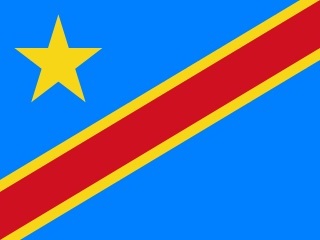
The Democratic Republic of the Congo (DRC), also known as the DR Congo, Congo-Kinshasa, or simply the Congo, and formerly named Zaire, is a country in Central Africa. By land area, it is Africa’s second-largest country and the world’s eleventh-largest. With a population of about 124 million people, the Democratic Republic of the Congo is Africa’s fourth-most populous country and the world’s most populous Francophone country. French is the official and most widely spoken language. The country has over 200 indigenous languages, of which Lingala is the most widely spoken. Kinshasa is the capital, largest city, and economic center. The DRC is bordered by the Republic of the Congo, the Cabinda exclave of Angola, and the South Atlantic Ocean to the west; the Central African Republic and South Sudan to the north; Uganda, Rwanda, Burundi, and Tanzania (across Lake Tanganyika) to the east; and Zambia and Angola to the south. Centred on the Congo Basin, most of the DRC’s terrain is covered by dense rainforests and is crossed by many rivers. The east and southeast are mountainous. In May 1960, a growing nationalist movement, the Congolese National Movement led by Patrice Lumumba, won the parliamentary elections. Lumumba became the first prime minister of the Republic of the Congo on 24 June 1960. French is the official language of the Democratic Republic of the Congo.
Christianity is the DRC’s predominant religion. In 2013, Christians made up 93.7% of the population, with Catholics at 29.7%, Protestants at 26.8%, and other Christians at 37.2%. A new Christian religious movement, Kimbanguism, had 2.8% adherence, while Muslims made up 1%. Other recent estimates have found Christianity to be the majority religion, with 95.8% of the population according to a 2010 Pew Research Center estimate. The CIA World Factbook reports this figure to be 95.9%. The proportion of Islam followers is estimated at 1% to 12%.
In 2014, the country had about 35 million Catholics, with six archdioceses and 41 dioceses. The Catholic Church’s impact is difficult to overestimate. Schatzberg has called it the country’s “only truly national institution apart from the state”. Its schools have educated over 60% of the nation’s primary school students and more than 40% of its secondary students. The church owns and manages an extensive network of hospitals, schools, and clinics, as well as many diocesan economic enterprises, including farms, ranches, stores, and artisans’ shops.
Sixty-two Protestant denominations are federated under the Church of Christ in the Congo. It is often referred to as the Protestant Church because it covers most DRC Protestants. With more than 25 million members, it constitutes one of the largest Protestant bodies in the world.
The Belgians saw Kimbanguism as a threat to the colonial regime and banned it. Kimbanguism, officially “the church of Christ on Earth by the prophet Simon Kimbangu”, has about three million members, primarily among the Bakongo of Kongo Central and Kinshasa.
Islam has been present in the Democratic Republic of the Congo since the 18th century, brought by Arab traders. Today, Muslims constitute approximately 1% of the Congolese population according to the Pew Research Center. The majority are Sunni Muslims.
The first members of the Baháʼí Faith to live in the country came from Uganda in 1953. Four years later, the first local administrative council was elected. In 1970, the National Spiritual Assembly (national administrative council) was first elected. Although foreign governments banned the religion in the 1970s and 1980s due to misrepresentations, the ban was lifted by the end of the 1980s. In 2012, plans were announced to build a national Baháʼí House of Worship in the country.
Traditional religions include concepts such as monotheism, animism, vitalism, spirit and ancestor worship, witchcraft, and sorcery, and vary widely among ethnic groups. The syncretic sects often merge elements of Christianity with traditional beliefs and rituals and are not recognized by mainstream churches as part of Christianity. New variants of ancient beliefs have become widespread, led by US-inspired Pentecostal churches which have been in the forefront of witchcraft accusations, particularly against children and the elderly.
Children accused of witchcraft are sent away from their homes and families, often to live on the street, which can lead to physical violence against these children. Charities such as the Congo Children Trust support street children. The Congo Children Trust’s flagship project, Kimbilio, works to reunite street children in Lubumbashi.
The usual term for these children is enfants sorciers (child witches) or enfants dits sorciers (children accused of witchcraft). Non-denominational church organizations have been formed to capitalize on this belief by charging exorbitant fees for exorcisms. Though recently outlawed, children have been subjected to often-violent abuse in these exorcisms at the hands of self-proclaimed prophets and priests.
District 10, Congo, Dem. Rep.
Province Notre-Dame Du Congo
Democratic Republic of the Congo
Hello Brother Emera,
Welcome to Eric Michel Ministries International as an inquirer about the French brotherhood.
Your task is to spread the gospel through the Media Missionary; mainly, here you will lead a group named Province of Our Lady of Congo.
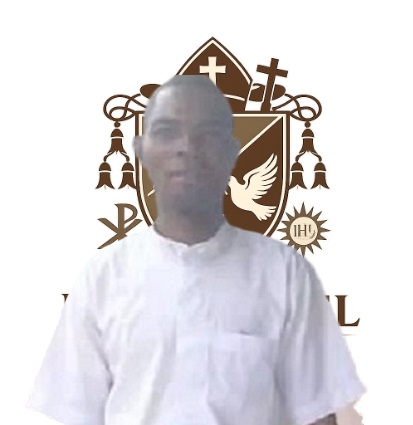
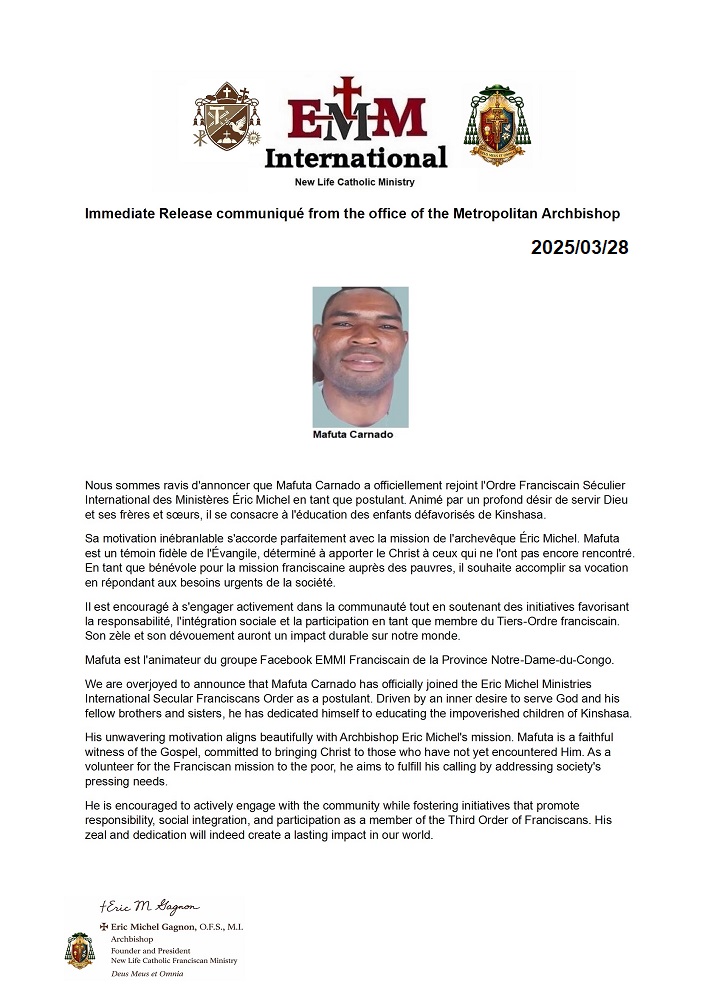
Paix sur toi, Mafuta Carnado
Province Notre-Dame-Du-Congo
Le groupe va bien et grossit.
Officiellement reconnu
- Brigitte Tayaya Mabuku
- Jeannette Bwafeya
- Bozi Alowa
- Bertin Isungu
- Guy Emingi
tous Invited by Mafuta Carnado, bravo, bravo.